iPhone logic board damaged? Fixed-price data recovery is possible.
iPhone logic board damaged? Data recovery is often possible! We explain what to do & when professional help is needed. Learn more now!
If the cause lies on the logic board, a iPhone logic board repair at a fixed price is the fastest solution: We analyse the board under a microscope and fix common faults such as baseband issues, bootloops, charging IC faults or short circuits.
A faulty iPhone is frustrating, especially when the logic board is damaged. Many people fear losing all their valuable photos, contacts and documents. But don't panic! Even if your iPhone's logic board is faulty, there is often still hope of recovering your data. We also explain the technical background so you can understand why some repairs are more complicated than others.
The iPhone logic board: The heart of your smartphone
The logic board (also known as the circuit board or mainboard) is the central component of every iPhone. It is a complex arrangement of interconnected electronic components that control all of the device's functions. The logic board contains the processor (CPU), random-access memory (RAM), flash storage (NAND), graphics chip (GPU), baseband chip (for cellular connectivity), Wi-Fi chip, Bluetooth chip, audio chip, charging IC (e.g. Tristar chip) and many other small components.
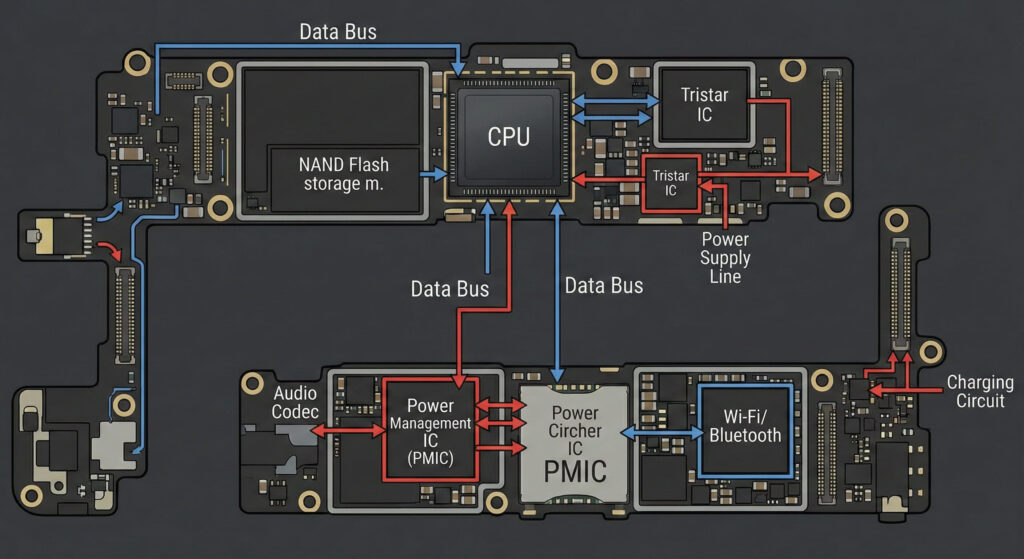
The evolution of the iPhone logic board: The logic board has evolved with each new iPhone generation. A major change came with the iPhone X. Apple introduced a stacked logic board design to save space and accommodate more components. This construction, in which two logic boards sit on top of each other and are interconnected, makes repairs even more complex and requires specialist tools and expertise.
Causes of iPhone logic board damage
There are various reasons why an iPhone logic board can become damaged. Here are some of the most common causes:
- Liquid damage: Water, coffee, juice or other liquids can cause short circuits and damage the electronic components on the logic board. Corrosion and oxidation often follow, potentially leading to failures over time.
- Drop damage: A fall can crack the logic board or break solder joints. Even if the device looks intact on the outside, there may be internal damage.
- Overvoltage: Faulty chargers or unsuitable power sources can cause overvoltage and damage the logic board.
- Overheating: Extreme heat, for example from direct sunlight or prolonged use under full load, can shorten component life and cause failures.
- Wear and tear: Like all electronic devices, the iPhone logic board is subject to natural wear and tear. After several years, components may fail or stop functioning properly.
Common problems and faults on the iPhone logic board
Logic board damage can cause various symptoms. Some of the most common problems are:
| Symptom | Possible cause(s) | Repair difficulty |
|---|---|---|
| iPhone will not turn on | Short circuit, faulty power IC, damaged solder joints | High |
| iPhone will not charge | Faulty charging IC (e.g. Tristar chip), damaged charging port, break in the charging circuit | Medium to high |
| No sound | Faulty audio IC, damaged audio traces, short circuit | Medium |
| No display | Faulty display IC, damaged display traces, short circuit | Medium |
| No cellular reception | Faulty baseband chip, damaged antenna traces, short circuit | High |
| Wi-Fi is not working | Faulty Wi-Fi chip, damaged antenna traces, short circuit | Medium |
| iPhone overheats | Short circuit, faulty IC, poor heat dissipation | Medium to high |
| Battery drains quickly | Short circuit, faulty battery, high power consumption caused by faulty components | Medium |
Data recovery for iPhone logic board damage: How it works
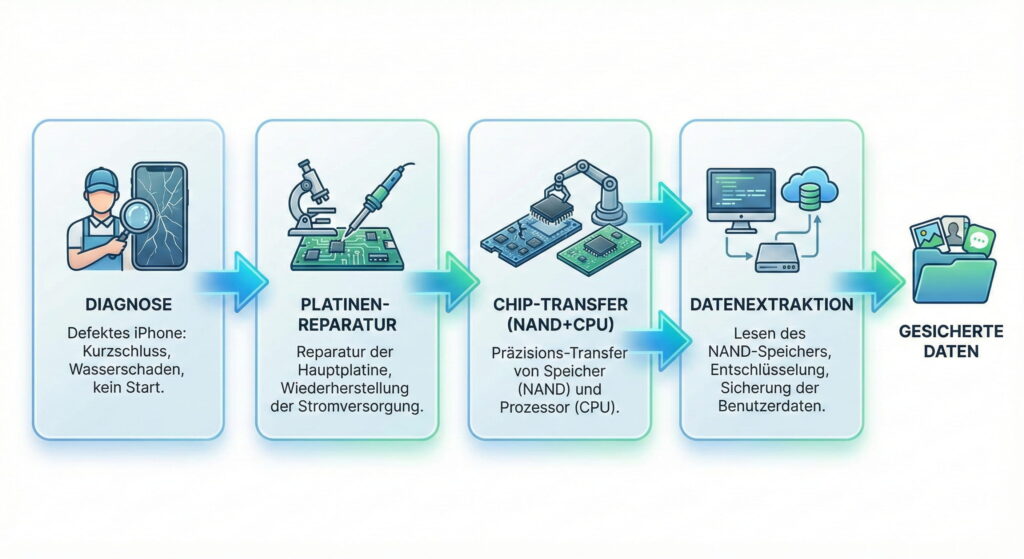
If your iPhone's logic board is damaged, data recovery is often challenging, but not impossible. The approach depends heavily on the extent of the damage and the type of fault. It is important to understand that iPhones use hardware encryption (Secure Enclave). This means that the flash storage (NAND) alone is useless without the encryption key. This key is inextricably linked to the iPhone's CPU (processor).
Common methods for recovering data from damaged logic boards are:
- Software methods: If the iPhone still boots up but has problems (e.g. boot loops or crashes), data can sometimes be extracted using software tools. However, this is only possible if the device is still partially functional and encryption is not fully enabled.
- Logic board repair: The most common and often most successful method is repairing the logic board. This involves replacing faulty components, repairing damaged solder joints and fixing short circuits. The aim is to get the iPhone working again so that the data can be backed up.
- Chip transfer (NAND + CPU): In some cases, the logic board is so badly damaged that repair is not possible. The flash memory (NAND) can then be transferred together with the CPU (processor) to an identical donor logic board. This is a highly complex procedure requiring specialist equipment and expertise. Important: The NAND and CPU must always be transferred together, otherwise the data cannot be decrypted.
- Forensic data analysis: In extreme cases where none of the methods above work, forensic data analysis can be attempted. However, this is very time-consuming and expensive and offers no guarantee of success.
Why chip-off does not work on iPhones
The “chip-off” method is often mentioned in connection with data recovery. This involves removing the flash memory (NAND) from the logic board and reading it directly. However, this method does NOT work on iPhones, because the data is hardware-encrypted. The NAND memory alone is unusable without the encryption key. The encryption key is permanently tied to the iPhone's CPU (processor). The data can only be decrypted if the NAND and CPU are transferred together to another logic board.
Logic board repair: The most demanding discipline in smartphone repair
Repairing an iPhone logic board is a demanding task that requires specialist knowledge and equipment. Standard phone repair shops are often unable to carry out such repairs because they lack the necessary expertise and technical capabilities. Even Apple itself does not offer logic board repairs, usually replacing the entire device instead.
What makes logic board repair so complex?
- Miniaturisation: The components on the iPhone logic board are extremely small and densely packed. Soldering and replacing them requires high-precision tools and steady hands.
- Circuit diagrams and documentation: Finding and fixing a fault requires detailed circuit diagrams and technical documentation. These are often not publicly accessible and require special software.
- Specialist tools: Logic board repairs require specialist tools such as microscopes, hot air rework stations, soldering stations, multimeters, oscilloscopes and special fluxes.
- Experience and expertise: Diagnosing and repairing logic board damage requires years of experience and a deep understanding of electronics. You need to be able to read circuit diagrams, identify components and find the causes of faults.
When is logic board repair worthwhile, and when is it not?
Whether a logic board repair is worthwhile depends on various factors:
- Value of the data: If the iPhone contains important data that has not been backed up, a repair may be worthwhile even if it is expensive.
- Age of the device: For older iPhones, an expensive repair is often no longer worthwhile, as the cost may exceed the value of the device.
- Type of damage: Simple faults such as a defective charging port are generally less expensive to repair than complex logic board damage.
- Cost of the repair: Get several quotes from specialist repair shops and compare prices. Consider not only the price, but also the shop's experience and expertise.
As a general rule: If the repair costs exceed 50% of the device's price when new, you should consider whether the repair is still worthwhile. In this case, buying a new or used iPhone often makes more sense.
HandyArzt: Your experts in iPhone data recovery and logic board repair
If all self-help measures fail and you have important data on your faulty iPhone, Handyarzt.com offers professional iPhone data recovery at logic board level. We specialise in repairing complex logic board damage and recovering data from faulty iPhones that other repair shops have deemed “beyond repair”.
Our expertise includes:
- Logic board-level repairs (microchip soldering, reballing)
- NAND chip data recovery
- Water damage recovery with ultrasonic cleaning
- iPhone/Android data extraction with a faulty display
- Chip-off data recovery for devices that will not boot (only unencrypted Android devices!)
- Forensic data analysis
- Firmware-level repairs
- JTAG/ISP data recovery
We have our own laboratory with professional equipment and a team of experienced technicians who specialise in repairing iPhone logic boards. Our success rate is high because we have the expertise and technical capabilities needed to resolve even the most difficult cases. We provide a transparent diagnosis before repair and give you an honest assessment of the chances of success.

Frequently asked questions
Logic board repair costs start at 99€. For more information, click Logicboard in the menu.
We recover your data at a fixed price
Professional data recovery at a fixed price.
iPhone, Samsung & more—including diagnosis and an encrypted USB drive. If unsuccessful, only a 29,90 € processing fee applies.
- ✓ Kostenlose Diagnose
- ✓ Bei Nichterfolg nur 29,90 €
- ✓ Data on a USB drive
- ✓ Diskrete Behandlung